If you are a foreign entrepreneur thinking about immigrating to Canada through the BC PNP Entrepreneur Stream, you have likely spent hours piecing together information from multiple government websites, immigration forums, and business listing platforms.
This guide brings all of it together in one place. By the time you finish reading, you will understand exactly how the program works, which stream applies to you, what the real risks are, how to find a business to buy, and what you need to do from your first inquiry all the way to permanent residency.
What Is the BC PNP Entrepreneur Stream?
The BC PNP Entrepreneur Stream is a pathway for experienced business owners and senior managers to immigrate to British Columbia by investing in and operating a business there. It is not a fast-track investor visa where you park money and receive residency. You must genuinely run a business, create jobs for Canadians, and demonstrate real economic benefit to the province. BC nominates you for permanent residency only after you have actually delivered on your commitments.
The program has two distinct streams: the Base Stream, which covers Metro Vancouver and other major urban centres, and the Regional Stream, which targets smaller communities outside the major cities. These two streams have different requirements, different processes, and different advantages. Choosing the right one is one of the most consequential decisions you will make.
Base Stream vs. Regional Stream: What Is the Difference?
The Base Stream
The Base Stream allows you to establish or purchase a business anywhere in BC, including Metro Vancouver, Victoria, Kelowna, and other larger cities. Because these are competitive markets with strong existing economies, the province applies stricter financial and scoring requirements. You need a higher net worth, a larger minimum investment, and a stronger overall profile to score competitively.
The BC PNP Entrepreneur Base Stream does not require you to visit a specific community before applying, and there is no community referral requirement. You register in the online portal, receive a score, and wait for an invitation to apply based on your ranking against other candidates in the pool.
The BC PNP Entrepreneur Base Stream is well-suited for entrepreneurs who want to operate in larger urban centres with access to infrastructure, skilled labour, suppliers, and established consumer markets. However, competition is intense, processing times can be long, and the threshold to receive an invitation is high.
The Regional Stream
The BC PNP Entrepreneur Regional Stream is designed to attract entrepreneurs to smaller BC communities that need new businesses, jobs, and economic investment. In exchange for committing to a specific community, applicants gain several advantages: lower minimum investment thresholds, higher scoring potential, a more defined process, and genuine community support that can make establishing a business much easier.
The key distinction is that the BC PNP Entrepreneur Regional Stream requires you to choose a specific participating community, visit it in person before applying, and obtain a formal community referral, a letter from local officials confirming they support your business proposal. This referral is valid for only 90 days, so timing matters.
The BC PNP Entrepreneur Regional Stream suits entrepreneurs who are flexible about which part of BC they settle in, want a faster pathway, or see opportunity in serving underserved local markets. Many of these communities have clear gaps in services such as healthcare, food manufacturing, accommodation, professional services, and education, which makes it much easier to write a compelling business proposal.
Who Qualifies under BC PNP Entrepreneur Stream?
While exact thresholds are set by BC PNP and may change, the program generally looks for applicants who:
- Have at least three to five years of business ownership experience or senior management experience in a relevant industry
- Have a minimum personal net worth (verified by an authorized accounting firm), which differs between Base and Regional streams and by investment size
- Are proposing an eligible business in an eligible industry
- Can demonstrate that funds were obtained legally
- Have language ability in English (or French), with higher scores available for stronger proficiency
- Have a genuine, viable, and well-researched business plan
Applicants do not necessarily need experience in the exact same industry as their proposed business. Strong general management experience and sufficient capital are often more important than sector-specific expertise. However, if you have directly relevant experience, it will significantly strengthen both your score and your proposal’s credibility.
The Step-by-Step Process: Base Stream
Step 1: Develop Your Business Plan
Before you touch the online portal, you need a credible, detailed business proposal. This document explains what the business will do, why the market supports it, what your relevant experience is, how much you will invest, how many jobs you will create for Canadians or permanent residents, and how the business will benefit BC’s economy. A weak business plan is one of the most common reasons for refusal. Do not treat this as a formality.
Step 2: Register Online
You create a profile through the BC PNP online portal. Your registration is scored based on your business experience, education level, English language proficiency, the amount you intend to invest, and the strength of your business proposal. The business concept is also separately reviewed by BC PNP officers, so both your score and the quality of your idea matter.
Registering does not guarantee an invitation. You enter a pool and compete with other registrants.
Step 3: Wait for an Invitation to Apply
If your score is competitive, BC PNP will invite you to apply. Before submitting a full application, an authorized accounting firm will verify your net worth and confirm the legal source of your funds. You cannot bypass this step.
Step 4: Submit Your Full Application
After receiving an invitation, you have four months to submit your complete application. This includes your full business plan, financial statements and personal net worth documentation, source of funds evidence, supporting documents about your experience, and the application fee. At this stage or shortly after, you may be called for an in-person interview. The interview covers your business experience, your proposal, and your plans to live in BC.
Step 5: Sign the Performance Agreement and Get a Work Permit
If BC PNP approves your application, you sign a Performance Agreement. This is a legally binding document specifying your investment amount, job creation commitments, business milestones, and the timelines within which you must achieve them. You then receive a Letter of Support to apply for a Canadian work permit through IRCC. You must apply for your work permit within 90 days of receiving this letter.
Step 6: Arrive in BC and Start the Business
Once you arrive in BC, you have up to 20 months to establish and actively operate your business in accordance with your Performance Agreement. This means making the investment, hiring employees, and running the business yourself. You must be physically present and genuinely managing the operations.
Step 7: Submit Your Final Report
Around 18 to 20 months after arriving, you submit a final report to BC PNP demonstrating that you met all your commitments, investment made, jobs created, business operating as described, and Performance Agreement fulfilled.
Step 8: Receive Provincial Nomination and Apply for Permanent Residence
If BC PNP is satisfied, they nominate you for permanent residency. You then apply to the federal government (IRCC) under the Provincial Nominee Program. Upon federal approval, you become a Canadian permanent resident.
The Step-by-Step Process: Regional Stream
The Regional Stream follows the same broad arc as the Base Stream but with an important set of additional steps at the front end.
Step 1: Choose Your Community
You must select a participating community from BC’s approved list of communities. These are towns and cities outside the major urban centres of Vancouver and Victoria. The choice matters enormously. Different communities have different priority sectors, different population sizes, different local markets, and different attitudes toward immigration. A community that is actively seeking food manufacturers or accommodation providers is far more likely to issue a referral for a relevant business than one that already has a surplus of restaurants.
Do your research. Look at what industries each community lists as priorities, what businesses are already operating there, what gaps exist, and whether the demographics and economy can support what you want to do. Visit the community’s economic development office website, look at local business listings, and read regional economic reports if available.
Step 2: Visit the Community in Person
Before applying, you must conduct what the program calls an exploratory visit. During this visit, you meet with local officials or economic development representatives, learn about the local market, discuss your business idea, and demonstrate genuine interest in living and working in that community. This visit is not a formality. Officials assess whether you are a serious candidate. Show up prepared with knowledge of the community, ask intelligent questions, and make it clear that you have done your homework.
Step 3: Obtain a Community Referral
After your visit, if the community supports your business idea, they may issue you a referral letter. The referral confirms that the community likes your proposal, that your business matches local needs, and that they support your application. This referral is only valid for 90 days, so you need to move quickly into the registration process after receiving it.
Not every visit results in a referral. If your proposed business does not align with the community’s needs or if they do not believe your proposal is realistic, they may decline. This is why choosing the right community for your specific business idea is so critical.
Next Steps
From this point onward, the BC PNP Entrepreneur Regional Stream process mirrors the Base Stream: online registration and scoring, waiting for an invitation, net worth verification, full application submission, potential interview, Performance Agreement, work permit, arrival in BC, operating the business, submitting the final report, receiving the nomination, and applying for permanent residence.
The Regional Stream adds one more requirement that the Base Stream does not have: you must actually live in the community where your business operates. You cannot operate a business in a small town while residing in Vancouver.
Real Challenges Applicants Face
Understanding the process on paper is one thing. Understanding what actually trips people up is another. Based on documented applicant experiences, here are the most common and serious obstacles.
Long and uncertain processing times. After submitting a full application, it can take many months before a decision is reached. During this period, your status changes from “Applied” to “In Process,” and there may be little communication. Many applicants find this waiting period stressful, particularly when they have already committed business resources or have family members waiting.
The interview. Not all applicants are interviewed, but many are. The interview is substantive. Officers want to understand your business experience in depth, probe your knowledge of the local market, and assess whether your proposal is realistic. Applicants who cannot speak credibly and in detail about their proposed business, the BC market, and their management experience tend to perform poorly.
The in-person interview visa problem. One of the most serious risks documented in real applicant experiences involves the requirement to attend an in-person interview in BC. If you are from a country whose citizens typically need a visa to enter Canada, and your visitor visa application is refused, you may be unable to attend the interview. If you cannot attend, BC PNP can decline your application. This is not a theoretical risk. It has happened. Applicants from certain countries should plan for this well in advance, potentially applying for a visitor visa early or exploring options for attending virtually.
The Performance Agreement pressure. Once you sign the Performance Agreement, the clock starts. You have specific timelines to invest, hire, and operate. If the business struggles, if permits are delayed, if the local market does not respond as expected, or if you encounter any of the dozens of normal business complications, you may find it difficult to meet your commitments on time. BC PNP can decline to nominate you if you do not fulfill the agreement, even if you have lived there for nearly two years.
Source of funds scrutiny. The accounting firm’s verification of your net worth and source of funds is rigorous. Funds obtained through complex ownership structures, gifts, loans, or arrangements that are difficult to document clearly can create problems. The cleaner and more straightforward your financial history, the smoother this step will be.
Choosing the wrong community. For the BC PNP Entrepreneur Regional Stream, selecting a community whose needs do not match your business idea, or where the population is too small to support your business model, can result in either a refusal of the community referral or a business that fails to perform once you arrive.
Priority Sectors by Community: Where Demand Is Highest
One of the most practical ways to improve your chances under the Regional Stream is to match your business idea to a community that explicitly lists your sector as a priority. Below is a breakdown of priority sectors for the participating communities covered in this guide’s research data.
Mackenzie (Northern BC): Support activities for crop production, support activities for forestry, mining and oil and gas support services, beverage manufacturing, miscellaneous manufacturing, sporting goods and hobby retailers, legal services, schools and instruction, amusement and recreation, traveller accommodation, RV parks and recreational camps.
Quesnel (Cariboo Region): Support activities for agriculture and forestry, specialty trade contractors, food manufacturing, wood product manufacturing, miscellaneous manufacturing, professional and scientific services, educational services, and ambulatory health care services.
Castlegar (West Kootenay): Wood product manufacturing, building material and garden equipment dealers, sporting goods and hobby retailers, miscellaneous manufacturing, general merchandise retailers, professional and scientific services, amusement and recreation, food services, electronics and appliances retailers, clothing retailers.
Columbia Valley / Invermere / Revelstoke Area: Crop production, wood product manufacturing, residential building construction, meat product manufacturing, motion picture and video production, management and technical consulting, traveller accommodation.
Kimberley: Other miscellaneous manufacturing, schools and instruction, educational support services, amusement and recreation industries.
Nelson (Kootenays): Computer and electronic product manufacturing, other wood product manufacturing, computer systems design, management and technical consulting.
Rossland: Residential and non-residential building construction, other wood product manufacturing, fabricated metal product manufacturing, computing infrastructure and data processing, traveller accommodation, special food services, drinking places, full-service restaurants.
Trail: Residential and non-residential building construction, alumina and aluminum production and processing, non-ferrous metal production, foundries, recyclable material wholesalers, computing infrastructure, and food services.
Bulkley-Nechako / Smithers Area: Crop production, animal production and aquaculture, timber tract operations, forest nurseries, logging, support activities for agriculture and forestry, sawmills, plywood and engineered wood, other wood products, medical equipment and supplies manufacturing, other miscellaneous manufacturing, amusement and recreation, traveller accommodation, RV parks.
Dawson Creek (Peace Region): Support activities for crop production, child day-care services, other amusement and recreation industries.
Fort St. John / Peace Region: Food services and drinking places, specialty food retailers, office supplies and gift retailers, book retailers.
Penticton (Okanagan): Food manufacturing, motion picture and sound recording, legal services, accounting and bookkeeping, architectural and engineering services, specialized design, management consulting, scientific research, advertising and public relations, other professional services.
Salmon Arm (Shuswap): Food manufacturing, machinery manufacturing, computer systems design, management consulting, other amusement and recreation.
Vernon (Okanagan): Grain and oilseed milling, fruit and vegetable preserving and specialty food manufacturing, bakeries, converted paper products, sporting goods and hobby retailers, accounting and bookkeeping, full-service restaurants, clothing retailers, furniture retailers.
Campbell River (Vancouver Island): Other food manufacturing, veneer and plywood manufacturing, scientific research and development, full-service restaurants, aerospace product and parts manufacturing, specialized design, computer systems design, traveller accommodation, beverage manufacturing, motion picture and video, warehousing and storage, freight transportation.
Comox Valley / Courtenay: Sugar and confectionery manufacturing, fruit and vegetable preserving and specialty food manufacturing, aerospace product and parts manufacturing, specialized design, computer systems design, scientific research and development, traveller accommodation.
Mount Waddington / Port Hardy / Port Alice: Specialty trade contractors, scenic and sightseeing transportation, motion picture and sound recording, performing arts, residential building construction, amusement and recreation, full-service restaurants.
Powell River: Aquaculture, resorts, motion picture and sound recording, computer systems design, food manufacturing, air transportation support, and scientific and technical consulting.
Nanaimo: Other food manufacturing, veneer and plywood, scientific research, full-service restaurants, aerospace, specialized design, computer systems design, traveller accommodation, and beverage manufacturing.
Prince George (Northern Interior): No specific priority sectors listed, but market demand supports food services, retail, accommodation, and general services based on the city’s size and regional role.
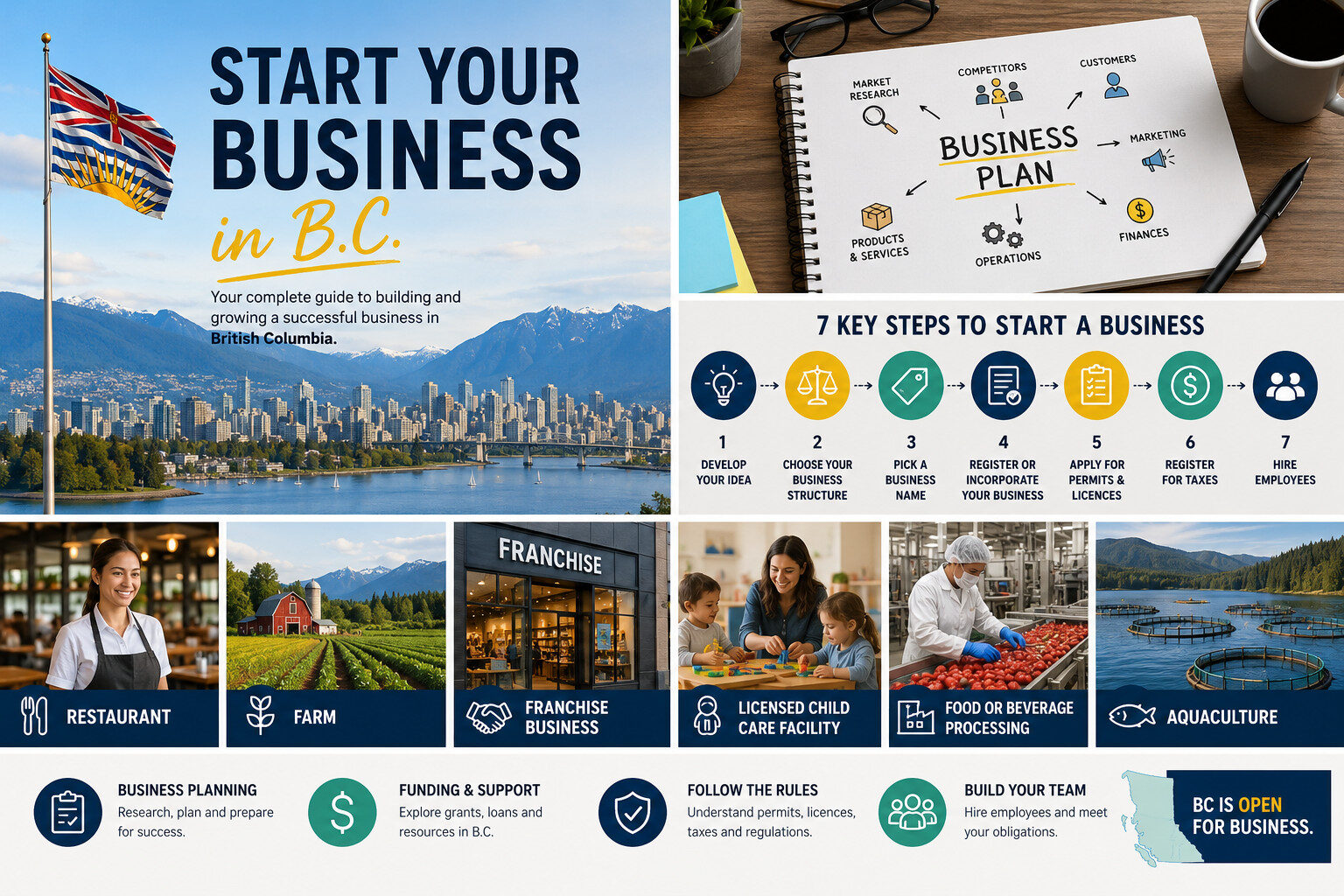
Starting a Farm or Agricultural Business
Agriculture is a priority sector in multiple BC communities and is an excellent fit for the BC PNP Entrepreneur Regional Stream. Communities like Quesnel, Smithers, Dawson Creek, and others in the Cariboo, Peace Region, and Bulkley-Nechako explicitly list crop production, animal production, aquaculture, and forestry support activities as priority sectors.
If you want to start a farm, here is what you need to know beyond the immigration pathway.
Business Structure for Farming
When you register your farming business in BC, you will choose between a sole proprietorship, a general partnership, or a corporation. For farm operations with external investment or employees, incorporation is often advisable for liability protection and tax planning. Small Business BC’s registration service costs $139 for a guided sole proprietorship or general partnership registration.
Agricultural Support Programs
BC has several programs supporting new farmers, including funding through the BC Ministry of Agriculture, the BC Farm Business Advisory Services program, and the Young Agrarians network. If your farm will employ workers, be aware that agricultural labour in BC is subject to specific employment standards, particularly around seasonal and foreign workers.
Buying a Franchise
Franchises are a popular choice for BC PNP Entrepreneur applicants because they come with an established brand, proven systems, training support, and often a recognized name that makes the business proposal more credible. However, the BC PNP Entrepreneur program applies the same scrutiny to franchise acquisitions as to independent businesses. You still need to demonstrate that the investment creates genuine economic benefit and that you will actively manage the operation.
When purchasing a franchise, you will need to present the franchise agreement as part of your business plan package. Franchise disclosure documents, royalty structures, and franchise fees should all be clearly presented in your application. BC PNP will want to understand what portion of your investment goes to franchise fees versus operational capital.
Buying a Restaurant
Restaurants are one of the most commonly available businesses for sale in BC and appear in virtually every community, from major cities to small towns. Several community profiles in this guide list full-service restaurants, food services, and drinking places as priority sectors. However, restaurants also carry well-known risks, thin margins, high staff turnover, regulatory requirements around food safety and liquor licensing, and sensitivity to local competition.
To find current restaurant listings, search realtor.ca, businessesforsale.com, and ovlix.com filtered by BC location. For smaller and regional communities, platforms like zolo.ca and commercialbc.com tend to have more local inventory.
Buying a Hotel, Motel, Lodge, or Accommodation Business under BC PNP Entrepreneur Stream
Traveller accommodation is a priority sector in many BC communities, particularly smaller ones that depend on tourism or serve as hubs for resource industries. This makes hospitality businesses a strong category for BC PNP Entrepreneur Regional Stream applicants.
To find current accommodation business listings, search realtor.ca for commercial/hospitality properties, loopnet.com for larger commercial hospitality assets, and businessesforsale.com.
Professional and Technical Services under BC PNP Entrepreneur Stream
For entrepreneurs with backgrounds in consulting, accounting, law, engineering, IT, or design, multiple communities list professional and technical services as priority sectors. This is particularly true of communities in the Okanagan (Penticton, Vernon), Kootenays (Nelson, Castlegar), Vancouver Island (Campbell River, Comox, Nanaimo), and Central Interior (Salmon Arm, Quesnel).
If you are starting a new professional services firm rather than buying an existing one, your business plan will need to demonstrate specifically why the community needs your service, how you will build a client base, and what your realistic revenue projections are based on local market conditions.
Starting a New Business vs. Buying an Existing One under BC PNP Entrepreneur Stream
You do not have to buy an existing business. BC PNP Entrepreneur accepts applications for new business startups. However, buying an established business has some practical advantages: you can demonstrate existing revenue, existing employees (which satisfies job creation requirements more easily), established customer relationships, and a track record that makes your business plan more credible.
If you start a new business, your proposal needs to be exceptionally well-researched. You will need to show market demand data, realistic financial projections, evidence of your ability to execute, and a clear explanation of why BC needs this business. New startups in priority sectors in underserved communities tend to receive more favourable consideration than new startups in saturated markets.
How to Register a Business Once You Arrive in BC under BC PNP Entrepreneur Stream
Regardless of whether you are buying an existing business or starting a new one, once you are in BC, you will need to complete several government registration and compliance steps. The Small Business BC starting checklist outlines the following:
Business structure: Choose between sole proprietorship, partnership, or corporation. For most immigrant entrepreneur operations with employees and external investment, incorporation is advisable.
Business name: Submit a Business Name Request (NR) for approval. Small Business BC offers this service for $50, or you can do it yourself through the BC Registries portal for $31.50.
Business registration: Register the business using your approved name. Small Business BC charges $99 for sole proprietorship or general partnership registration, or you can do it yourself for $40 through sbbc.co/registerbusiness.
Business bank account: Open a dedicated business bank account at any Canadian financial institution. Bring your Business Registration Certificate.
Business licence: Contact your municipality for a local business licence. Visit civicinfo.bc.ca or call your local city hall.
GST and PST registration: If your gross annual revenue exceeds $30,000, you must register for a GST account with the Canada Revenue Agency (1-800-959-5525). PST has no revenue threshold for most businesses — register with the BC Ministry of Finance (1-877-388-4440 or gov.bc.ca/pst).
Industry-specific licences and regulations: Visit bcbizpal.ca to determine whether your industry requires any specific federal or provincial licences or permits. Restaurants, health clinics, childcare centres, and financial services businesses all face additional regulatory requirements.
Insurance: Contact the Insurance Bureau of Canada (ibc.ca) to determine what coverage your business requires.
If you hire employees:
- Review the BC Employment Standards Act: contact the BC Employment Standards Branch at 1-800-663-3316
- Set up a payroll deductions account with CRA
- Register for WorkSafeBC workers’ compensation coverage (604-244-6181 or worksafebc.com)
Record keeping: BC law requires you to retain all business records for six years. Retain a qualified accountant or certified bookkeeper from the beginning.
Financing Your BC Business
Banks and other lenders in Canada will typically require a written business plan before approving a business loan. As a new permanent resident or work permit holder, access to credit may be more limited initially because you will have no Canadian credit history. Strategies to address this include:
- Bringing sufficient capital to cover at least the first year of operations without relying on Canadian credit
- Working with banks that have experience serving immigrant entrepreneurs (some major banks have dedicated programs)
- Exploring BDC (Business Development Bank of Canada) loans, which are designed specifically for small businesses and are often more accessible to new business owners
- Using Small Business BC’s financing advisory services (smallbusinessbc.ca)
Your Performance Agreement specifies your minimum investment commitment. Make sure your financial plan is structured so that you meet this requirement and still have working capital to operate.
The Market Research Step You Cannot Skip
One of the most common mistakes in BC PNP Entrepreneur stream business proposals is presenting a business plan that is generic and not grounded in the specific local market. BC PNP officers know the communities they administer. A proposal claiming that a certain community lacks a sushi restaurant when it already has three will be dismissed immediately.
Before you write your proposal for the BC PNP Entrepreneur Stream, do the following:
- Visit the community (which the Regional Stream requires anyway)
- Research what businesses are already operating there using Google Maps, Yelp, and local directories
- Talk to the local economic development office about what is missing
- Review census and demographic data for the community on Statistics Canada’s website
- Check whether the community has a business attraction strategy or investment prospectus (many BC communities publish these)
- Look at commercial real estate vacancy rates to understand the health of the local economy
Small Business BC offers market research coaching and education services through sbbc.co/marketresearchadvice if you need structured assistance.
Working with Immigration Professionals
The BC PNP Entrepreneur Stream involves complex immigration law, business law, and government relations. Most successful applicants work with a Regulated Canadian Immigration Consultant (RCIC) or a Canadian immigration lawyer. An experienced professional can help you choose the right stream, structure your application, prepare for the interview, and respond to any complications that arise.
When selecting a professional, verify their credentials through the College of Immigration and Citizenship Consultants (CICC) for RCICs, or the Law Society of British Columbia for immigration lawyers. Be cautious about unregulated agents who claim to guarantee results or charge unusually low fees.
Timeline: How Long Does the Whole Process Take?
The full BC PNP Entrepreneur Stream process from initial registration to permanent residency typically spans three to four years or more, broken down roughly as follows:
- Application preparation and community visit (Regional Stream): one to three months
- Waiting for an invitation to apply after registration: variable, often six months to a year or more
- Full application review and potential interview: six months to over a year
- Work permit processing after approval: several weeks to months
- Operating the business under the Performance Agreement: 20 months
- Nomination and federal permanent residence application: one to two years
Total timelines vary considerably based on the stream, the quality of your application, how quickly you are invited, and IRCC processing times for the federal permanent residence stage.
Frequently Asked Questions
Do I need to speak English fluently? English proficiency is scored, but there is no absolute minimum cutoff for the entrepreneur stream. Higher proficiency improves your score and your ability to conduct business in BC.
Can my spouse work in BC while I operate the business? Your spouse may be eligible for an open work permit once you have your BC PNP work permit. This is worth confirming with an immigration professional, as eligibility rules can change.
Can I live in Vancouver but run a business in a regional community? No, under the Regional Stream, you must live in the community where your business operates.
What happens if my business fails partway through? If you cannot fulfill your Performance Agreement due to circumstances beyond your control, you should contact BC PNP as early as possible to discuss options. However, if you simply stop operating the business, you will not receive a nomination and may face complications with your immigration status.
Can I buy a property-based business like a mobile home park or RV park? Yes, these are eligible businesses. Several are listed in BC, including mobile home parks in Cranbrook and Courtenay, and RV parks in various communities.
Is childcare an eligible business? Yes, child day-care services are a listed priority sector in Dawson Creek and may be eligible in other communities. The sector is in high demand across much of rural BC.
Can I invest in a business but have a manager run it for me? No. You must actively manage the business yourself. Passive investment structures are not eligible.
What is the minimum investment? Minimum investment thresholds vary by stream and community and are updated by BC PNP periodically. You should confirm current thresholds directly with BC PNP or through an immigration professional before building your financial plan.
Key Resources and Contact Information
- BC PNP Online Portal: www.bcpnponline.gov.bc.ca
- Small Business BC: smallbusinessbc.ca
- Business Registration (self-service): sbbc.co/registerbusiness
- Business Name Request (self-service): sbbc.co/namerequest
- BC BizPal (licences and permits): bcbizpal.ca
- Canada Revenue Agency (taxes and business number): 1-800-959-5525
- BC Ministry of Finance (PST): gov.bc.ca/pst
- WorkSafeBC: worksafebc.com
- BC Employment Standards Branch: 1-800-663-3316
- Business listings: realtor.ca, businessesforsale.com, ovlix.com, zolo.ca, commercialbc.com, realtylink.org, globalbx.com, loopnet.com
- Farm and rural properties: farmsforsaleinbc.ca, landquest.com, youngagrarians.org
- Regional community economic development: visit each community’s official website (links vary by municipality, see the BC PNP community list for current participating communities)
- BC PNP Entrepreneur Immigration Streams
Final Thoughts
The BC PNP Entrepreneur Stream is a rigorous but achievable pathway for serious business owners who are genuinely committed to building something in British Columbia. The program rewards applicants who have done their research, chosen their community thoughtfully, developed a credible and specific business plan, and are prepared to deal with the real challenges of starting and running a business in a new country.
The most important things you can do are: choose a business that genuinely serves a need in the community you are targeting, demonstrate that you have the experience and capital to execute, prepare your documents meticulously, and work with qualified professionals. BC is actively seeking entrepreneurs who will create jobs and contribute to local economies. If you can show that you are one of them, the pathway to permanent residency is real.
To book a consultation: https://pcici.ca/consultation
Free Checklist: Download Here